Last fall, we moved to a house in the suburbs, with both a front and rear lawn. We’ve never enjoyed mowing the lawn, and now know that a lawn is bad for the ecosystem — since it is relatively ecologically sterile, provides little to no food for pollinators, has shallow roots resulting in flooding from heavy rains, and expensive to maintain.
My grandmother had a bungalow surrounded by mango and guava trees, but that was on a different continent. My husband’s grandfather would return home with pockets full of seeds from fruit he had enjoyed during his travels. Over time, he had many varieties of fruit surrounding their home. That too was on another continent. In their memories, we decided we would like fruit trees in our suburban yard in Southeastern Pennsylvania. But what types? I made a list of fruits we liked, and then checked with a friend.
Noah of Noah’s Gardens and Mike Hoag’s post about selecting trees for a forest garden, taught me about intensive and extensive fruit trees and shrubs. Intensive fruit trees require a lot of work; an example is an apple tree. Extensive fruit trees produce fruit with almost no care; an example is mulberry. Semi-intensive fruit trees lie somewhere in the middle, and would need some work. So the idea is to have a few intensive fruit trees, and several extensive fruit trees.
I’ve since refined our plant list to include these intensive fruit trees… a plum, a peach, and two cherry trees. And these semi-intensive trees… a pear and a persimmon. All for the front yard.

The numerous extensive shrubs and fruit trees would be mostly in the backyard, though a few ended up in the front. The current tally is… two blackberry, four currant, six raspberry, and 15 blueberry bushes plus two mulberry, two elderberry, four pawpaw, two figs and a winter hardy pomegranate tree.
We have seen deer and rabbits on the property so each tree may need fencing for protection until it gets taller. I’ll also need to plant accompanying plants, a symbiotic guild, around each fruit tree bed. I’ve learned, for instance, that:
- There are plants with strong roots that pull up minerals from deep in the soil. These are accumulators. Dandelion is one example, bringing up calcium for the fruit tree.
- Other plants invite pollinating insects and are called insectary plants. An example is bee balm.
- Repellants are plants, often with a strong scent, that deter insects that damage our fruit tree. Marigold is a repellant.
- Some plants are simply prolific growers, covering the ground beneath the fruit tree so there’s no room for weeds! Less labor and keeps the soil from drying out. These are called the mulch makers. An example is comfrey.
- Then there are the nitrogen fixers, which take nitrogen from the air and pull it down into the soil, which the fruit trees can access. Clover and peanuts are good examples.
- Barrier plants are good to border the bed, preventing the lawn and other weeds from from creeping in. An example is parlsey.
Many plants play multiple roles, so it could be an accumulator as well as an insectary, and even be medicinal. Again, the dandelion plays many of these roles. Who needs chemical fertilizers, pesticides and herbicides when we’ve got a guild of plants on the scene, right? We’ve so much more to learn from other species!
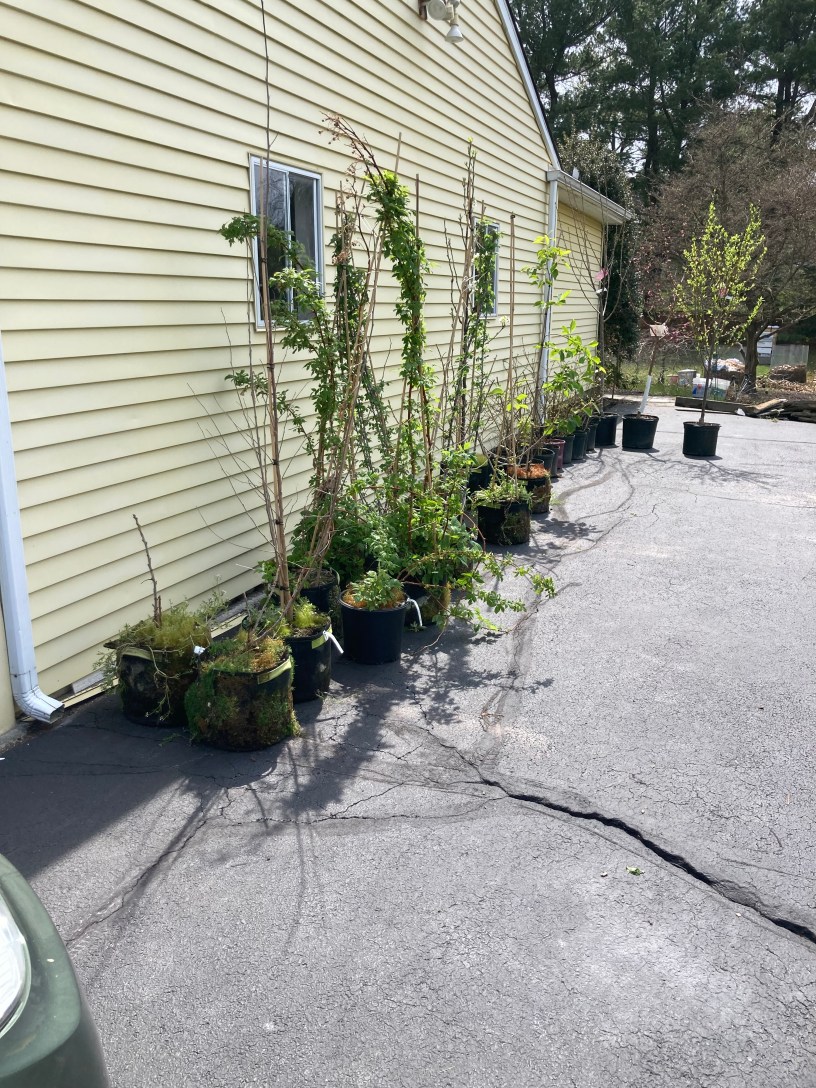
My friend Noah, even though near Asheville NC, recommended local sourcing for our needs so we spent a week driving to nearby nurseries for the trees and shrubs, staging them on the side of the house. Pretty remarkable fellow, and one I highly recommend for your permaculture / garden design needs! He can be reached here.
 musings of a gujarati-american gal
Please publish the final plan!
If you’re not convinced about replacing your lawn, read this (https://www.grunge.com/846877/the-surprising-history-of-grass-lawns), where Doug Tallamy is quoted as “People don’t realize that their two acres of lawn have just wrecked the watershed, killed all the pollinators, not sequestered enough carbon and destroyed the food web.”