
I had heard the phrase Vipassana Meditation, but didn’t quite know what it was. My friend Noah had mentioned taking a course in Australia years ago. Other friends Rajesh & his wife are committed to this practice, as is their son. When I met this 22 year old, I was wowed by his intensity, his clarity, and his sincerity. Turns out his mother got him to sign up for a 10 day Vipassana course after finishing high school. The mother’s surprise was that he signed himself up upon finishing college and before starting his first job. I remember her saying… My job as a mother is done; he has Vipassana now [to help him course correct throughout his life]. I knew that my mother, too, had taken a Vipassana course in Rajkot, Gujarat.
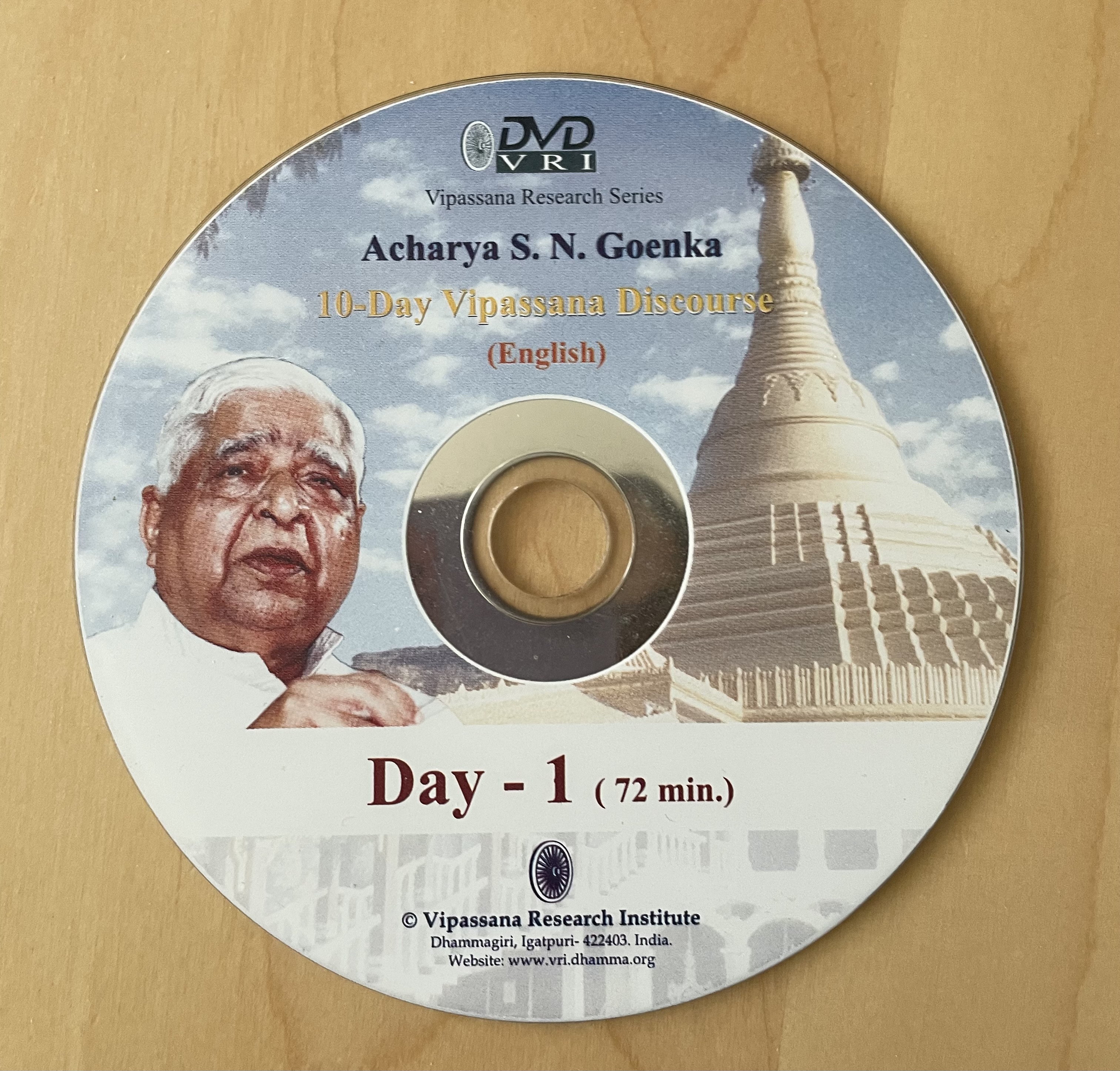
But it was while culling my mother’s music collection that I came across a set of CDs with SN Goenka’s nightly discourses about Vipassana Meditation. Not having a clue, I popped the first CD into the player, and was drawn in by Goenkaji’s golden voice. Upon listening for a whole hour, I asked my friend Rajesh about it. Rajesh cautioned that I need to do the work, that I stop listening and instead sign up for a 10 day course!
So began my journey…
This was last October, when I signed up for the 10 day Vipassana course at the end of December, at a center less than an hour’s drive from my home.
What course? A course on Vipassana meditation as taught by SN Goenka in the tradition of Sayagyi U Ba Khin. It seems the technique discovered and taught by Gautama the Buddha had been preserved in Pali text, and sustained by monks in Myanmar (formerly Burma). In the last century, this technique was learned and developed by Sayagyi U Ba Khin, a Burmese civil servant. SN Goenka learned from U Ba Khin. And since Goenka was skilled not just in Burmese but also a great orator in Hindi and English, took the teachings back to India and, eventually, the West.
On my shelf, I found two books on Vipassana by Dr Paul Fleischmann, an American psychiatrist. While waiting for the course, I learned a little more through these books.
Vipassana is a journey of self exploration, to aid in seeing things as they are. Some call it the art of living, since the meditation focuses on eliminating the three causes of all unhappiness — craving, aversion and ignorance. A by-product of this practice is the eradication of psychosomatic ailments. It can also help with addiction and anger issues by quieting the mind, focusing on the present, reducing regrets by dwelling less on the past, worrying less about the future, etc.
During the course, one begins by committing to the five precepts of abstaining from killing, from stealing, from sexual misconduct, from wrong speech (lying, gossip, etc), and from intoxicants. Seemed easy enough, just for the 10 days. I liked that it defined a set of values for all the students. What this meant was a vegetarian diet, no locks on interior doors, and a separation of men and women. We were also committed to noble silence, meaning no talking or even eye contact with other students, only with the teacher and course manager, if needed. I enjoyed the quiet, but did feel unloved the first few days when no one made eye contact!
The days started with meditation at 4:30, and ended at 9 after an evening of meditation and a video lecture (called discourses) by Goenkaji. There was a hot breakfast and a lunch each day, but only tea and fruit for dinner. I ate well and slept well, but it certainly was an exhausting few days.
I thought meditation was meditation, focusing on the breath. But Vipassana Meditation is different. We begin with the breath, then move onto focusing on sensations on one part of the body. And gradually, to all parts of the body. There seems to be a mind-body connection, where sensations are related to reactions, so that a focus on awareness of sensations without reacting to them leads to a calmer mind in everyday life! A balancing act of awareness and equanimity.
Volunteers (AKA Dhamma Servers) cooked for the 40 of us, and surrendering to complete strangers caring for me was a new experience. The food was vegetarian with vegan options, even gluten free options. There was a variety of sliced breads and tortillas (like roti), but mainly we ate grains that could be cooked in bulk — like rice, oatmeal and quinoa. Lunchtime entrees rotated between various ethnicities — Indian, Italian, Chinese, Japanese, Mexican — showcasing options from around the world, and for various palates. The first few days, I altered the hot meals by adding salt and hot sauce. And tried the black caffeine tea. Realized that part of the lesson is to not be so reactive to my preferences and began eating, even savoring, what was served up! Huge lesson.

Returning home, I spoke of the experience to anyone who might listen. I seemed so changed, so much calmer and at peace, that my husband signed up for the next course in early March! Courses fill up so fast that new students need to apply 2 to 3 months in advance of these free courses. There are centers all over the world now, which you can see at dhamma.org.
Another change I noticed in myself is that the five precepts lingered on in me. For instance, I seemed to be less interested in joining my partner for a glass of beer or wine!
Every young person starting out in life should have this experience, to learn to sit and listen to oneself, instead of to parents, teachers and friends or even printed material, be they scriptures, textbooks or the vast Internet.
If interested, see these two videos showcasing Vipassana’s journey from Myanmar to the world.
Interestingly, the 10 day course has been taken to prisons in India, the US, and Brazil. I found it fascinating to see angry men sit with their anger and find peace.
- The Indian experience in Tihar jail, New Delhi — Doing Time, Doing Vipassana
- The US experience in Donaldson Facility, Alabama — Dhamma Brothers
- The Brazilian experience — Vipassana – the Path of Liberation
Busy people have told me they can’t spare 10 days to just sit around! So I’ve found this 30 minute recording where Goenkaji starts with Anapana meditation (follow the breath), leads you into Vipassana meditation (awareness and equanimity of sensations), and ends with Metta Bhavana meditation (cultivating loving kindness for all sentient beings). This could be a good start for you. Goenkaji’s discourses (the nightly one hour talks) can be found online also, but really, everything I find says to take the 10 day course!
The magic seems to be in the surrender during the course, to the food, the volunteers serving, the unlocked doors, avoiding eye contact and conversation, the day long meditation sessions, the early morning arising, the segregation of men and women, the disconnect from the outside world, even the no stealing pledge (I’d borrowed cushions from a shelf that stated do not remove!).
My preferred center is Dhamma Pubbananda in Claymont Delaware USA. You may find me volunteering in the kitchen or garden here as a Dhamma Server.
 musings of a gujarati-american gal